
In short: Yes, there is a helium shortage in 2026. Helium production at Qatar’s Ras Laffan complex, which supplied around a third of the world’s helium, was disrupted in early 2026, and shipping out of the Gulf is still heavily restricted. Helium spot prices roughly doubled, and repairs to the damaged facilities are expected to take three to five years. Helium users can’t fix supply, but they can cut how much liquid helium they lose. This guide explains how.
Yes. Since March 2026, the world has been in a helium shortage, after Qatar, which supplies about a third of the world’s helium, stopped production (CBS News).
Qatar produced 63 million of the world’s 190 million cubic metres of helium in 2025, about a third of global supply (USGS). In early September 2026, ship-tracking firm Kpler recorded only five to 11 vessels a day crossing the Strait of Hormuz, a fraction of normal traffic (Al Jazeera).
QatarEnergy has since partially restarted helium production, but at a fraction of normal capacity, and exports remain limited by shipping restrictions (ChemAnalyst). Helium users have been drawing on stored inventory to keep running (Forbes, citing Reuters). But supply remains tight, and the underlying problem has not gone away.
The shortage comes from the loss of one of the world’s biggest helium sources, combined with blocked shipping and little spare capacity elsewhere.
Helium is recovered as a by-product of natural gas processing. Qatar’s helium is produced at Ras Laffan Industrial City, which also houses the world’s largest LNG production facility (NGI). In March 2026, gas production at the complex, and the helium that comes with it, was halted during the regional conflict, and missile strikes later damaged parts of the site (S&P Global).
The damage has proved serious. QatarEnergy says the damaged facilities will take three to five years to repair (S&P Global), partly because replacement gas turbines take two to four years to deliver (The National). QatarEnergy expects the damage itself to cut its helium exports by around 14% while repairs are carried out (Marine Insight). The Strait of Hormuz, the sea route out of the Gulf, remains largely closed to commercial shipping.
Helium cannot be manufactured. It comes from a small number of gas fields, and new processing and liquefaction plants take years to build.
For decades, the US Federal Helium Reserve acted as the market’s buffer. It was sold to Messer in June 2024 (US Bureau of Land Management), so there is no large government stockpile left to release.
The users hit hardest are those with no substitute for helium: MRI scanners, chipmakers and low-temperature research.
Most MRI scanners use liquid helium to keep their superconducting magnets cold. Critical uses such as MRI are generally prioritised for supply (Reuters, via AGBI), but top-ups now cost more and deliveries are less certain. Conventional MRI magnets hold around 1,500 litres of liquid helium. Newer sealed designs need as little as 7 litres (Philips).
Chipmakers use helium to cool wafers and tools, and as the standard gas for leak detection in vacuum chambers, because helium atoms are small enough to find microscopic leaks. It also cools ASML’s EUV lithography machines, which make the most advanced chips (Tom’s Hardware).
South Korea is especially exposed. Samsung and SK Hynix make much of the memory used in AI servers, and in March they were reported to hold about four to six months of helium inventory (Forbes, citing Reuters).
Data centres do not use liquid helium for cooling, but high-capacity hard drives are sealed with helium gas (Tom’s Hardware). So the shortage reaches data centres through chips and drives.
Universities and research labs use liquid helium to keep NMR spectrometer magnets and low-temperature experiments cold, and these instruments need regular top-ups. Many quantum computers are cooled by dilution refrigerators that run on helium, although many newer systems are “dry” and need far less liquid helium day to day.
Helium supply is being rationed. Liquid helium is shipped in cryogenic ISO containers that can hold it for only 35 to 48 days before it boils off, and around 200 of them were reported stranded near the Strait of Hormuz (Forbes). Customers have received force majeure and allocation letters from suppliers (CBS News). With little spare capacity elsewhere, buyers have very few alternatives in the short term (Reuters, via World Energy News).
Helium spot prices roughly doubled as buyers scrambled for alternative supply, according to helium consultant Phil Kornbluth (Reuters, via World Energy News).
The price of liquid helium depends on your country, volume and contract, and buyers without long-term contracts are hit hardest (Reuters, via World Energy News). Wholesale helium is usually priced in US dollars per thousand cubic feet (Mcf) of gas. With repairs expected to take three to five years, prices are unlikely to fall back quickly. That makes every litre you avoid losing worth more than it was a year ago.
Liquid helium boils at −269°C (4.2 K, or −452°F). That is only about 4 degrees above absolute zero, making it the coldest liquid there is. One litre of liquid helium turns into about 754 litres of helium gas at room temperature (Air Products).
Liquid helium is used wherever something must be kept colder than any other liquid can manage. There is no substitute for helium in cryogenic applications below −429°F (−256°C) (USGS). The main uses are:
Liquid helium is lost at every stage it is stored, moved or used, because even a tiny amount of heat makes it evaporate.
No container is perfectly insulated. A little heat always leaks in, so some helium evaporates every day. This is measured as the static evaporation rate, a percentage of the dewar’s capacity lost per day. For example, a 250-litre dewar losing 0.8% a day loses about 2 litres daily, or about 730 litres a year, before anyone uses it.
Moving helium from one container to another loses more. The transfer line has to be cooled down first, and that cooling uses up helium. Every connection, and every minute a line stands warm, adds to the loss.
Anything that has warmed up must be cooled down again before it can hold liquid helium. The helium used to cool it evaporates and is gone. This applies to a dewar left to warm up, and to the equipment being filled.
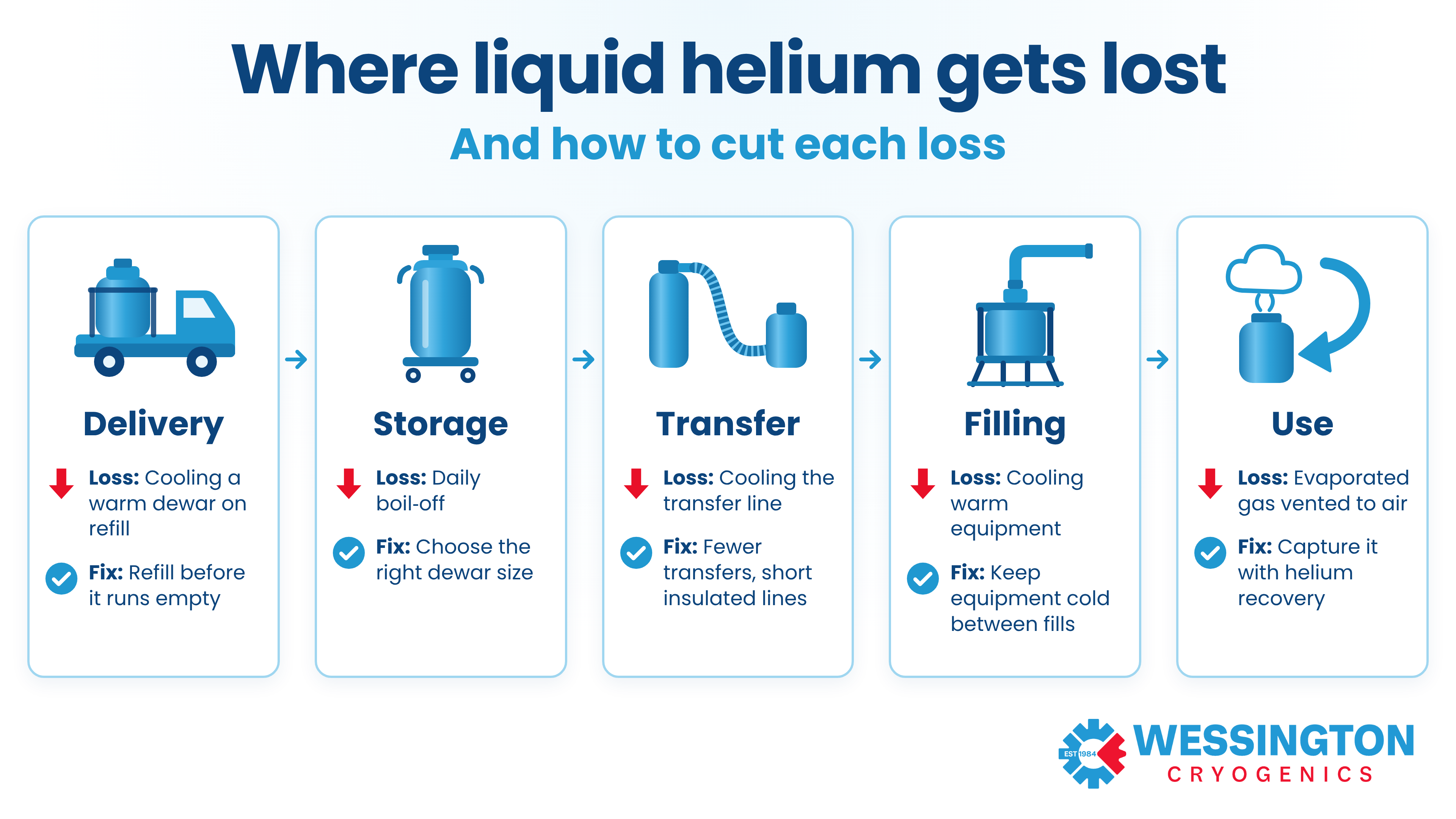
The biggest savings come from the right dewar size, fewer transfers, keeping equipment cold and capturing the gas that evaporates.
Larger dewars lose a smaller percentage of their contents each day. A 30-litre dewar can lose 2.8% a day, while a 20,000-litre bulk dewar loses 0.2%. But a dewar far bigger than you need still loses litres every day on helium you are not using. Match the size to how much you actually use between deliveries.
A dewar that runs empty and warms up must be cooled again before it holds liquid. That cooling costs helium. Refill before it runs dry, and avoid long idle periods where you can.
Every transfer costs helium to cool the line and connections. Plan transfers together, rather than several small ones. Use short, vacuum-insulated transfer lines, and keep connections well sealed.
Helium recovery captures the gas that evaporates, instead of venting it to air. The gas can then be reliquefied on site or returned for reprocessing. Wessington’s portable CH Series dewars include a helium recovery valve and KF25 connection as standard, so they can be connected to a recovery system.
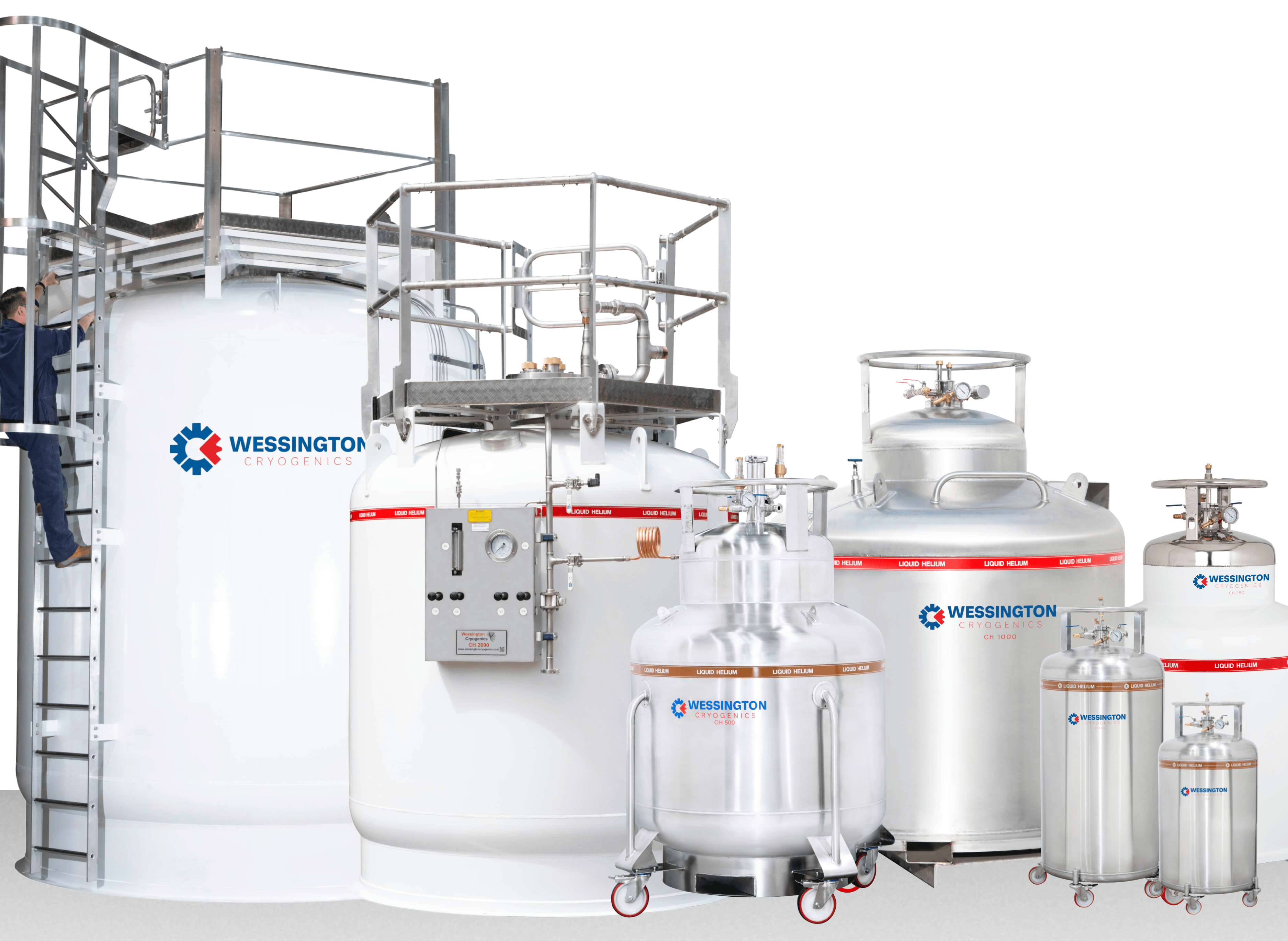
Wessington CH Series dewars range from 30 litres to 20,000 litres. Portable models (30 to 1,000 litres) are designed to TPED and approved for transporting full on European roads. CH Bulk models (1,000 to 20,000 litres) are used with liquefiers or for bulk storage. Portable CH models carry a 5-year vacuum warranty.
Evaporation rates fall as size goes up: from 2.8% a day for the CH30, to 0.5% for the CH1000, and 0.2% for the largest CH Bulk models. Full specifications for every model are on the product pages:
Not in the ground, but supply is fragile. Most of the world’s helium comes from a few gas fields and plants, so damage to one site or shipping route causes shortages.
Not quickly. QatarEnergy expects repairs to the damaged facilities at Ras Laffan to take three to five years, and there is no government reserve left to release. New helium projects, such as those in the US and Canada, will take time to add supply.
It depends on the dewar’s size and evaporation rate. For example, a CH250 losing 0.8% a day loses about 2 litres daily at its datasheet rate. Real use, with filling and transfers, increases losses.
In a vacuum-insulated dewar designed for liquid helium, fitted with pressure relief devices, in a well-ventilated area. Never store liquid helium in a sealed container, because it expands about 754 times as it turns to gas.
No. Liquid nitrogen boils at −196°C (−321°F), far warmer than liquid helium. Some systems use liquid nitrogen for pre-cooling or as a heat shield, which reduces helium use.
It depends on size, neck and valve configuration, and options such as level meters. Contact our team for a quote on the model you need.
Yes. Wessington designs and manufactures CH Series dewars at its UK factory and has delivered them to customers all over the world, including Antarctica.
Wessington Cryogenics has designed and built cryogenic vessels in the North East of England since 1984. If you want to reduce helium losses, size a new dewar or repair an existing one, our technical team can help.